Massachusetts rideshare drivers call for unionization amid falling wages
By Sydney Woogerd – Jan 13, 2026
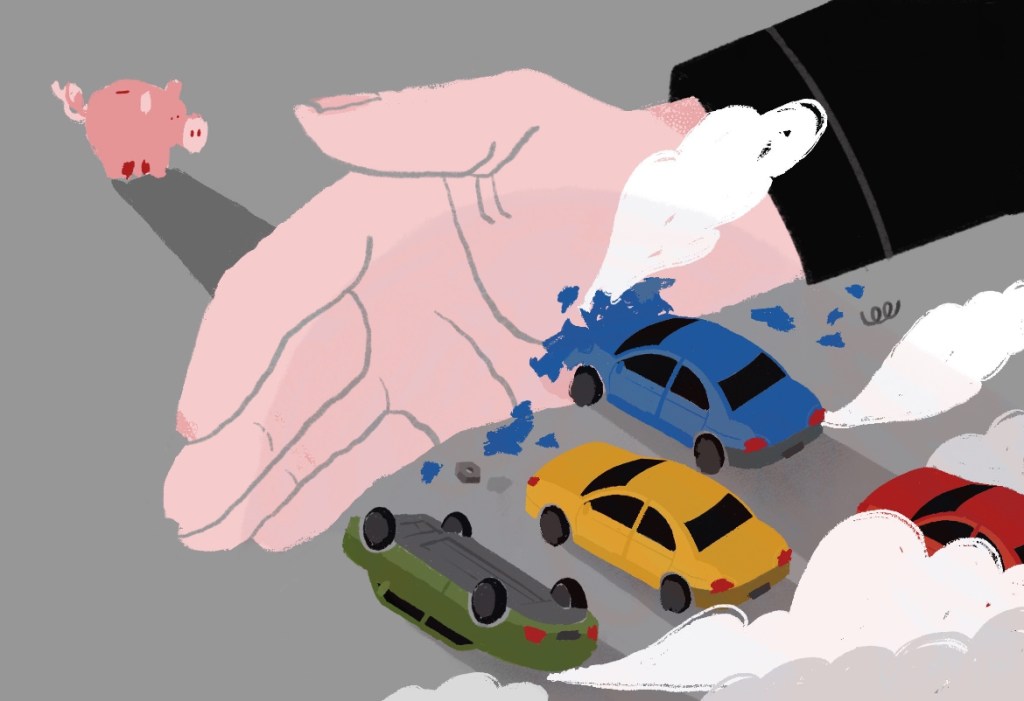
This article was published in The Huntington News: Massachusetts rideshare drivers call for unionization amid falling wages
Every evening, Duane Mitchell — a 73-year-old semi-retired software development consultant — opens his Uber app, grabs his keys and walks out of his home in Roslindale, Massachusetts to his blue 2015 Subaru Forester. From there, he sets off to Boston, where he has worked as a rideshare driver for ten years. After around four hours of picking up and dropping off passengers and sitting at red lights, Mitchell returns home having made little more than $100.
Since the Massachusetts Department of Public Utilities, or DPU, began publishing rideshare driver applications in 2017 as part of its annual reports, nearly 1.5 million drivers have been background-checked and approved by the state as of 2024. According to DPU, nearly 100,000 drivers in Massachusetts are actively working for one or both of the two main rideshare apps: Uber and Lyft.
Despite the popularity of a flexible job like rideshare driving, many workers hold major grievances against their companies. One of their main complaints is low wages, especially in a state with the second-highest cost of living in the country.
“Uber and Lyft are coming into our city and taking lots and lots of money out of it. They’re not paying the drivers enough to make a decent living, and on top of that, the drivers have to go to the state to get [financial] assistance.” Mitchell said. “I think every citizen in the state of Massachusetts should have an interest in this, because this is some real gangster stuff … middle-class Americans need to fight these corporate tech people.”
Inadequate wages haven’t always been the norm for rideshare drivers, according to Jenn Nickerson, a driver and freelance web designer living in the North Shore of Massachusetts. Having driven for Uber over the past six years to support herself and her family, Nickerson said she knows firsthand how things have changed.
“The money you’re getting paid per trip has really declined a lot. So it seems like Uber is taking more and more of a share of what the trip costs,” Nickerson said.
As a result, drivers need riders to fill the gap, Mitchell said. Daily interactions with customers have changed as drivers rely more heavily on tips to pad their wages.
“When Uber started, there was no tipping. People would say, ‘Let me give you a tip.’ I said, ‘No, you don’t have to. I’m getting paid enough.’ That’s not true anymore,” Mitchell said. “I don’t think [rideshare organizations] care. All they care about is profit. I think they’re making good profit now, and I don’t see why they can’t pay us enough. They used to.”
In June, Len Sherman, an executive in residence and adjunct professor of marketing and management at the Columbia Business School, published a paper titled “How Uber Became A Cash-Generating Machine.” The paper presents the results of a study conducted by Sherman and his graduate students to explain Uber’s $12 billion increase in free cash flow after consistently declining flow before 2022. Such financial change triggered “one of the greatest turnarounds in business history,” Sherman said.
The conclusion connected Uber’s mid-2022 “upfront pricing” initiative — which bills riders before they are matched to a ride — to a decrease in overall profits seen by drivers. A nationwide analysis by Gridwise Analytics in 2025 surveyed over 250,000 rideshare drivers, the results of which support Sherman’s findings. Gridwise noted that Uber drivers’ hourly earnings have dropped by 3.9% from 2023, while Lyft driver earnings have dropped by 5.5%. On a regular basis, drivers are making less as their companies make billions.
While drivers used to be paid predictable wages based on mileage and time, Sherman said he now believes that rideshare companies use a secret algorithm to charge riders the most they are willing to pay and offer drivers the lowest-paying jobs they are willing to take, subsequently increasing their profit margin.
“They’re taking full advantage of this significant information advantage they have over individual riders and individual drivers, and it’s serving them extremely well,” Sherman said. “On each and every trip, they [are] making more money than they [ever have].”
This shift and the rapid change in rideshare companies’ profit is not going unnoticed by the drivers in the community.
“If you ask any drivers right now, all of them, their income dropped to 30-40%,” said Farouk Yahi, a 39-year-old rideshare driver of six years. “Uber and Lyft right now are taking advantage of the drivers and the riders.”
Uber did not reply to requests for comment on the possible effects of their new “upfront pricing” initiative. However they did respond to Sherman’s research arguing that their pricing is “designed to be transparent and fair for both riders and drivers.”
“Suggestions that our systems manipulate pricing unfairly or discriminate are simply false and not supported by evidence,” Uber said.
Uber did not reply to any further requests for comment.
Similarly, Lyft said in a 2024 press release that they know the “importance of transparency in maintaining trust in the communities we serve.”
“We are obsessed with improving the driver experience,” Audrey Liu, The Executive Vice President of Lyft, said. “drivers having control is core to the Lyft experience.”
However, Sherman said he believes Uber still “dramatically underestimates the intelligence of their driver community.”
“It’s almost insulting the communications that Uber has with its drivers, its exploitative behaviors,” Sherman said. “The short answer is, drivers are completely aware of the way that they’re being taken advantage of, and there’s not much they can do about it.”
While it’s less probable that individual drivers could directly alter company-defining policies, the community is finding that creating change as a collective may be more plausible. In July 2024, after months of protesting and advocating, Massachusetts rideshare drivers started a ballot initiative allowing state residents to vote on whether drivers should have the right to unionize.
Previously, drivers were not permitted to unionize because they were classified as independent contractors rather than employees. But in November, with the support of 54% of state voters and two of the largest union organizers in the world — 32BJ Service Employees International Union, or SEIU, and the International Association of Machinists and Aerospace Workers — the initiative was passed.
Still, the effort has a long way to go before drivers can officially be declared a union and begin negotiations with Uber and Lyft.
“[They] are big corporations, and it’s so hard to beat them,” Yahi said. “[But] with the union, we’re gonna have the power to negotiate a better contract and better pay and access to retirement programs and access to health insurance.”
In June 2024, only months before the ballot initiative was voted on and approved, the Massachusetts Attorney General’s Office entered into a settlement agreement with Uber and Lyft, ending a four-year-long battle. The settlement established a $33.48 per hour minimum wage for drivers based on their “active time,” guaranteed a maximum of 40 hours a year of sick leave and gave drivers a stipend for various benefits such as health insurance and paid medical leave.
Still, the rideshare driver community is looking to receive increased health insurance benefits, company transparency, wages based on miles and time, protection from unfair deactivations and various user interface adjustments through unionization.
Rahim Abbasi is an activist and 32BJ SEIU organizer behind the App Drivers Union, which is what. As a second-generation union organizer, he deeply believes in the power of a united workforce.
“A union is what will give working people a fair shot. I would say the American worker doesn’t have a chance without a union,” Abbasi said. “I was a driver, and I was like, ‘Oh, these wages are not sufficient. We need something else to be done.’”
While starting a union may be the ideal solution for some, other individuals are more hesitant. According to Yahi, many drivers were afraid the unionization effort would lead to an unwanted shift in one of the community’s values: work flexibility.
There are people outside the community who believe the union may also misrepresent drivers because of the low 25% signature threshold required to begin negotiating. In most cases, the National Labor Relations Board requires aspiring unions to obtain the approval of 50% of workers to be immediately certified. A lower signature baseline may be more likely to misrepresent the whole community, but due to the nature of rideshare work being completely independent from any one workplace with atypical hours and a high turnover rate, the nuance of this particular unionization lies in the difficulty of reaching drivers, making it extremely tedious to collect a majority vote.
“The hardest thing about this campaign is that there’s no work site,” Abbasi said. “The drivers are spread across the whole state, and you have to go look for them.”
Currently, the aspiring union group is doing just that. According to the new Massachusetts law, once the group has proven support from 5% of active rideshare drivers, they will be given a list of all active drivers across the state to aid their efforts. From there, they need to receive an additional 20% to be recognized as an official union. Once established, they will begin creating contracts and negotiating with rideshare organizations, like Uber and Lyft, in Massachusetts to fight for a voice in the industry.
“Some people will be pro-union, some people will be anti-union. But when you dig into the issues, most people just want the same thing,” Abbasi said. “They just want to go home safely at the end of the night, making a fair wage.”
 Sydney Woogerd